
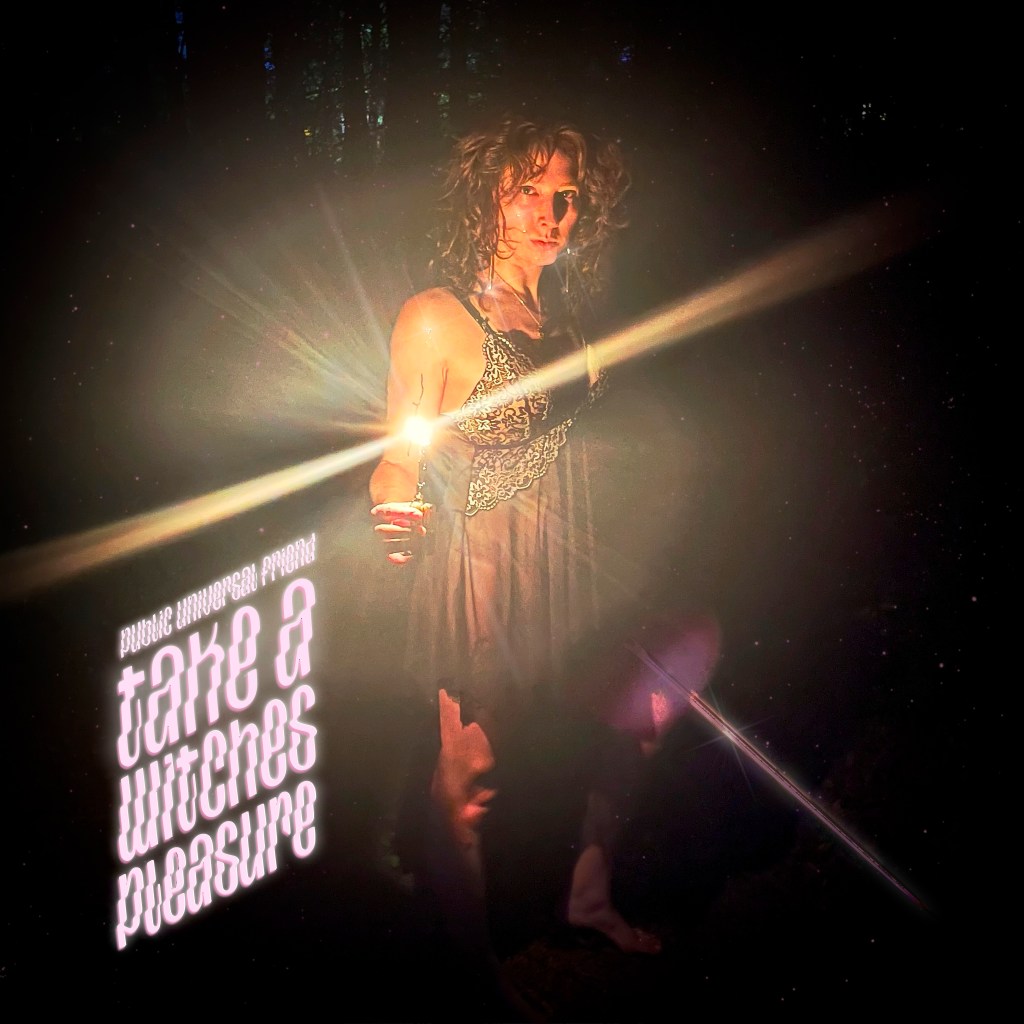
Public Universal Friend (PUF), the Portland, Oregon-based queer Appalachian doom punk band, present Take a Witches Pleasure, the latest iteration of their ever-deepening sound, the logical next step for a songwriter so unwavering in lyrical intent and emotional power central to every PUF record since the beginning.
Appalachian-born songwriter Jody Galadriel Friend set out to write about the legends of the woods of her native Great Smoky Mountains, the spirits and folk tales of entities beyond imagining, and in the process found that the language used for describing the witches inhabiting the switchback valleys of the ancient land were perhaps more reminiscent of how the American conversation sounds regarding trans women: mysterious, alluring, dangerous, off-limits, fascinating, powerful, and referred to in whispers breathed by those too afraid to humanize them.
Take a Witches Pleasure is about the experience from the inside, the reconciling of mythologies and appropriation, the brute exploitation of the relationship between the infinite divine nature of trans people and the demonization of their existence by the very voices that wish them silent, yet desirable.
Not an instant into the first track, “Crush,” there is no question as to the nature of such complicity. This, along with the following “fuckmarrykill,” and “Trauma Del Rey,” we are met with the raw humanization of one grappling in the throes of betrayal and bitter malcontent abrading a sensitive spirit in a world seemingly bent on its complacent invisibility. Nine years since its first introduction into the tome of Friend’s confessional pre-transition opus, we are gifted with a new edition of “Lower, Permission,” a legend of recompense asking the endless question: will the worldly mind ever relent to the truth and power of the “irrational” oracle-heart? In the aftermath of this reverberate, “Smoky Mountain Witchcraft” serves as the hinge of the record, bringing home the questions at the center of the suffering, the echoing subterranean mouth giving proclamation to a becoming of that which is most feared, a mirror into the magnitude of the shadow for any who dare gaze into it.
The funeral song of peace in which to rest that is “Hellena Hagstone” brings a personal tender center of nuance into this grief narrative, wherein the author gives audience to the one weeping over that which never existed, calling into question the nature of trans reality: was there ever a before in the way we imagined it, or was it always now, only obscured from our then-definitions of what is possible to be? The final chapters of this arc reach through to the archetypal abyss of self, pronounced by the Entity found only at the end of loss, in the absolution of self-possession traversing the other side in “Black Swan.” Finally the dark of night rests upon the edge of stillness as “Hermaphrodyke Hex” draws up its thunderous dance, a life borne in spite of the hate that should plea to keep it buried, the hammer of power brought down, the blade of retributive treatise finding its mark upon the vein of the malice once primed in its vanity, fruitless, a vessel of rot in the face of the transfeminine diablos; no longer the altar’s victim of sacrifice, but the very hand that should end its reign of terror, unspooling the wretched sinews of its undoing.
Influences drawn upon besides the galling realities of American trans life include imagining if Die Spitz, Courtney Love, and Brody Dalle of the Distillers put Witch, Sleep, & Electric Wizard on leashes, got Thou to produce it, packaged it like Emma Ruth Rundle, released with the budget of music store sales associate. Take a Witches Pleasure was recorded during the transition songwriter Jody Galadriel Friend made (beyond that of the corporeal form) across the country from Indianapolis to Portland after the results of the November 2024 election, when it became clear that Indiana was so longer a viable place to live as a trans person under fascism. Through the quiet in-betweens of grieving an outgrowth in leaving nest of transformation so long called home, after watching every dream of the last nine years fade under political duress, economic inviability, the void of generational poverty, lack of industry interest, and divorce-debt, rounded out otherwise by being a walking thought crime, these songs were salvaged as a way of coping through the opaque impossible, a strangely unrelenting ideal to surviving, or perhaps deciding to create regardless of an audience of any magnitude, for the sake of making something vital: a sustenance of substance, perhaps to an audience no further than a brick may be thrown, but worth it nonetheless.
Since the previous PUF record, Chrysalis, Friend released her memoir, Transangelicism: memoir of a transgender ex-vangelical to spirited local acclaim in 2024, whose admittedly bleak takes on love founded a real-world reconnection to her high school crush, the establishment of this pillar of life anew demanding a fascinating lens be vulnerably employed through which to view finalizing an album written about anger and grief.
What do humans do best? We process our grief through making things, through opening our hearts little by little, again and again, there we find ways to be reminded of what is real amidst the bullshit, and we try again and again until we can’t because it’s what we do, then we do it again. Sometimes that’s the only reason, but it’s enough. Perhaps with no cosmic underpinning apart from what its actual, though writing about grief in the midst of it and then producing it in its aftermath is a feat of testament in itself, it serves perhaps only as as a living reminder of life after death; of the little deaths we walk through, the lessons we revisit, the actualization reformed in its necessity, the nature of life being grief, our relationship to it, and deciding to live through a world so blatantly misdirected in its angst looking in its own mirror, which is what trans people do best.
This is Take a Witches Pleasure.

